

Conic sections were discovered during the classical Greek period, 600 to 300 B.C. The conic sections are figures that can be formed by the intersection of a plane with a cone. There are four basic conic sections: circles, ellipses, parabolas and hyperbolas.
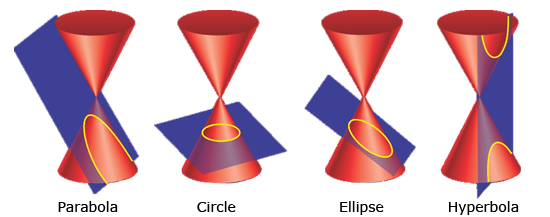
A conic section can be formally defined as: the set of points in a plane whose distances from a fixed point bear a constant ratio to the corresponding perpendicular distances from a fixed straight line. The fixed point is called the focus and the fixed straight line is called the directrix of the conic section. The constant ratio is called the eccentricity of the conic section and is denoted by e.

When the eccentricity is 0, that is, e = 0, the conic section is called a circle;
When e = 1, the conic section is called a parabola;
When e < 1, the conic section is called an ellipse;
When e > 1, the conic section is called a hyperbola.
The general equation for all conic sections is: Ax2 + Bxy + Cy2 + Dx + Ey + F = 0 with A, B, C not all zero.
Recognizing conics
The equation of a conic is of the form ax2 + 2hxy + by2 + 2gx + 2fy + c = 0 ...... (i) and its
discriminant is Δ = abc + 2fgh – af2 – bg2 – ch2.
Case: 1 If Δ = 0, then (i) represents the degenerate conic and the nature of the conic is given in the following table:
| S.No | Condition | Nature of conic |
|---|---|---|
| 1. | Δ = 0 and ab – h2 = 0 | A pair of coincident straight lines |
| 2. | Δ = 0 and ab – h2 > 0 | A point |
| 3. | Δ = 0 and ab – h2 < 0 | A pair of intersecting straight lines |
Case: 2 If Δ ≠ 0, then (i) represents the non-degenerate conic and the nature of the conic is given in the following table:
| S.No | Condition | Nature of conic |
|---|---|---|
| 1. | Δ ≠ 0, h = 0, a = b, e = 0 | A Circle |
| 2. | Δ ≠ 0, ab – h2 = 0, e = 1 | A Parabola |
| 3. | Δ ≠ 0, ab – h2 > 0, e < 1 | An Ellipse |
| 4. | Δ ≠ 0, ab – h2 < 0, e > 1 | A Hyperbola |
| 5. | Δ ≠ 0, ab – h2 < 0, a + b = 0, e = √2 | A Rectangular Hyperbola |