Examples
Ex 1:
PS and QR are equal perpendiculars to a line segment PQ. Show that RS bisects PQ
Sol:
| In ΔQOR and ΔPOS | ||
| ∠QOR | = | ∠POS (vertically opposite angles) |
| ∠RQO | = | ∠SPO (each 90°) |
| QR | = | PS |
| ∴ ΔQOR | ≅ | ΔPOS |
| RS bisects PQ | ||
Ex 2:
In figure PR = PT, PQ = PS and ∠QPS = ∠TPR, Show that QR = ST
Sol:
| Given that ∠QPS | = | ∠TPR |
| ∠QPS + ∠SPR | = | ∠TPR + ∠SPR |
| ∠QPR | = | ∠SPT |
| Now in ΔQPR and ΔSPT | ||
| PQ | = | PS |
| ∠QPR | = | ∠SPT |
| PR | = | PT |
| ∴ ΔQPR | ≅ | ΔSPT |
| ∴ QR | = | ST |
Ex 3:
PQ is a line segment and T is its mid-point. R and S are points on the same side of PQ such that ∠QPR = ∠PQS and ∠STP = ∠RTQ. Show that
(i) ΔRPT ≅ ΔSQT
(ii) PR = QS
Sol:
| Given that ∠STP | = | ∠RTQ |
| ∠STP + ∠RTS | = | ∠RTQ + ∠RTS |
| ∠RTP | = | ∠STQ |
| Now in ΔRPT and ΔSQT | ||
| ∠RPT | = | ∠SQT |
| PT | = | QT |
| ∠RTP | = | ∠STQ |
| ∴ ΔRPT | ≅ | ΔSQT |
| ∴ PR | = | QS |
Ex 4:
Prove that the perpendiculars drawn from the vertices of equal angles of an isosceles triangle to the opposite sides are equal.
Sol:
Given A ΔABC in which ∠BCA = ∠CBA, BL ⊥ AC and CM ⊥ AB.
To prove: BL = CM.
Proof:
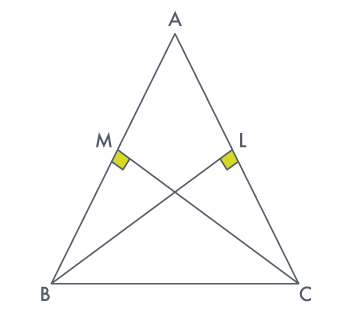
In ΔBCL and ΔCBM, we have:
| ∠BCL | = | ∠CBM [∵ ∠BCA = ∠CBA] |
| BC | = | CB (common) |
| ∠BLC | = | ∠CMB = 90° |
| ∴ ΔBCL | ≅ | ΔCBM (AAS – Criteria) |
| Hence, BL | = | CM (c.p.c.t) |
Ex 5:
If the altitudes from two vertices of a triangle to the opposite sides are equal, prove that the triangle is isosceles.
Sol:
Given ΔABC in which BL ⊥ AC and CM ⊥ AB such that BL = CM.
To prove:AB = AC.
Proof:
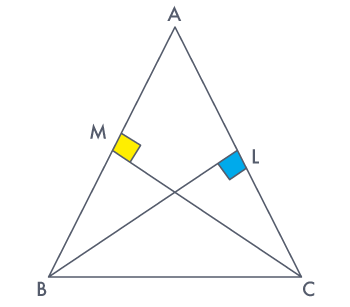
In ΔABL and ΔACM, we have:
| ∠ALB | = | ∠AMC [each equal to 90°] |
| ∠BAL | = | ∠CAM (Common), BL = CM (Given) |
| ∴ ΔABL | ≅ | ΔACM (AAS – Criteria) |
| ∴ AB | = | AC (c.p.c.t) |
| Hence, ΔABC is isosceles. | ||
Ex 6:
6. Prove that the medians of an equilateral triangle are equal.
Sol:
Given A ΔABC in which AB = BC = AC, and AD, BE and CF are its medians
To prove: AD = BE = CF.
Proof:
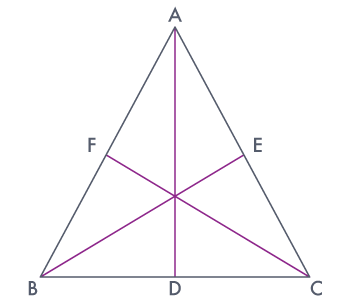
In ΔADC and ΔBEA, we have:
| DC | = | EA [BC = AC ⇒  BC = AC] BC = AC] |
| ∠ ACD | = | ∠ BAE [each equal to 60°] |
| AC | = | AB(given) |
| ∴ ΔADC | ≅ | ΔBEA (SAS-criteria) |
| ∴ AD | = | BE (c.p.c.t). |
| Similarly, BE | = | CF. |
| Hence, AD | = | BE = CF. |