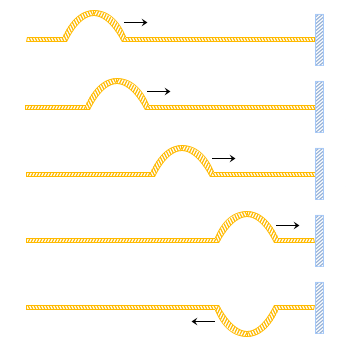
The figure shows a pulse travelling along a stretched string and being reflected by a rigid boundary.
It suffers a phase change of π or 180° on reflection. If the boundary point is not rigid but completely free to move (such as in the case of a string tied to a freely moving ring and amplitude (assuming no energy dissipation) as the incident pulse. The net maximum displacement at the boundary is then twice the amplitude of each pulse. Let the incident travelling wave be represented by the equation
yi = a sin(kx-ωt+π).
At a rigid boundary, the reflected wave is given by
yr =
a sin(kx-ωt+π).
= -a sin(kx-ωt)
At an open boundary, the reflected wave is given by
yr = a sin(kx-ωt+0),
= a sin(kx-ωt).