(a) Velocity components along the axis:
From mirror formula,
(1/u) + (1/v) = 1/f
Differentiating the above formula on both sides with time, we get
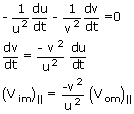
(vim)∥ = Velocity of image w.r.to mirror along the principle
axis
(vom)∥ = Velocity of object w.r.to mirror along the principle
axis
Velocity component perpendicular to principle axis:
m = hi/ho
⇒ hi = mho
Differentiating the above equation on both sides w.r.to time, we get
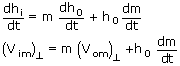
(vim)⊥ = Velocity of image w.r.to mirror perpendicular to the
principle axis
(vom)⊥ = Velocity of object w.r.to mirror perpendicular to the
principle axis
 = rate of change of
magnification
= rate of change of
magnification
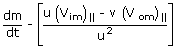
m = – V/U
By differentiating this equation on both sides w.r.to time, we get
POSITION AND NATURE OF IMAGE FORMATION IN SPHERICAL MIRROR
Image formation in concave mirror:
| S.No | Position of object | Position of image | Nature of image |
|---|---|---|---|
| 1 | At ∞ | At F | Real and inverted image,| m | << 1. |
| 2 | Between C and ∞ | Between F and C | Real and inverted image,| m | < 1. |
| 3 | At C | At C | Real and inverted, | m | = 1. |
| 4 | Between F and C | Between C and ∞ | Real and inverted, | m | > 1. |
| 5 | At F | At infinity | Real and inverted, | m | >> 1. |
| 6 | Between F and P | Behind the mirror | Virtual and erect, | m | > 1. |
Image formation in convex mirror:
| S.no | Position of object | Position of image | Nature of image |
|---|---|---|---|
| 1 | At ∞ | At F | Virtual and erect, | m | << 1. |
| 2 | Anywhere between ∞ and P | Between P and F | Virtual and erect, | m | < 1. |
Position, size and nature of image formed by the spherical mirror
| Mirror | Location of the object | Location of the image | Magnification, size of the image | Nature | |
|---|---|---|---|---|---|
| Real Virtual | Erect inverted | ||||
(a) Concave 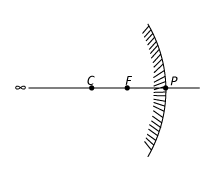 |
At infinity, i.e., u = ∞ | At focus, i.e., v = f | m << 1, diminished | Real | inverted |
| Away from center of curvature (u > 2f) | Between f and 2f, i.e., f < v < 2f | m < 1, diminished | Real | inverted | |
| At center of curvature u = 2f | At center of curvature, i.e., v = 2f | m = 1, same size as that of the object | Real | inverted | |
| Between center of curvature and focus: F > u > 2f | Away from the center of curvature v > 2f | m > 1,magnified | Real | inverted | |
| At focus, i.e,. u = f | At infinity, i.e., v = ∞ | m = ∞, magnified | Real | inverted | |
| Between pole and focus u < f | v > u | m > 1,magnified | virtual | erect | |
(b) Convex 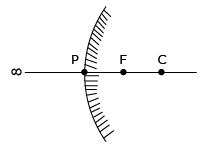 |
At infinity, i.e., u = ∞ | At focus, i.e., v = f | m < 1, diminished | virtual | erect |
| Anywhere between infinity and pole | Between pole and focus | m < 1, diminished | virtual | erect | |
| Linear magnification | Areal magnification | |
|---|---|---|
| Transverse | Longitudinal | |
| When a object is placed perpendicular to the principle axis, then linear
magnification is called lateral or transverse magnification. It is given by 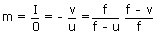 (*Always use sign convention while solving the problems) |
When object lies along the principle axis then its longitudinal magnification
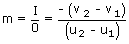 If object is small; 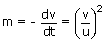 Also length of image = (v/u)2 × Length of object (L0) 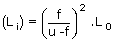 |
 If a 2D – object is placed with its plane perpendicular to principle axis Its areal magnification  ⇒ ms = m2 = Ai/A0 |