A hemispherical body is placed in a uniform electric field E. The flux linked with the curved surface, if field is
(i) parallel to the base
(ii) perpendicular to base and
(iii) if a charge q is placed at its centre can be calculated as follows
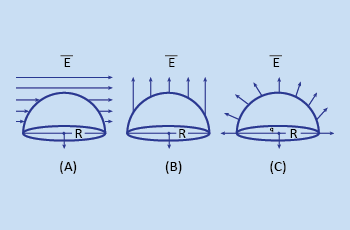
Considering the hemispherical body as a closed body with a curved surface and a plane base (cross-section), the flux linked with the body will be zero as it does not encloses any charge i.e.,
ϕ = ϕCS + ϕPS = 0......(1)
(i) As field is parallel to base, the flux linked with Base
ϕPS = E × πR2 cos90° = 0
Substituting this value of ϕPS in Eq.(1),
we get: ϕCS = 0
(ii) As field is perpendicular to base, the flux linked with base
ϕPS = E × πR2cos180° = –πR2E
So substituting this value of ϕPS in Eq.(1),
We get ϕCS = πR2E
(iii) Total flux through the Gaussian surface(sphere) = (q/ϵ0)
∴ Flux through hemisphere = (q/2ϵ0)
If a point charge is kept at the center of a face of the cube, the first we should enclose the charge by assuming a Gaussian surface (an identical imaginary cube)
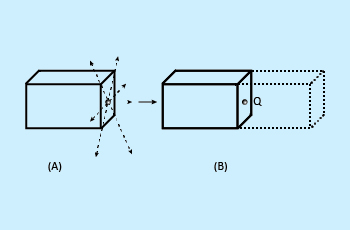
Total flux emerges from the system (Two cubes) is ϕtotal = (Q/ϵ0)
Flux through the given cube is ϕcube = (Q/2ϵ0)
If a point charge is kept at the corner of a cube
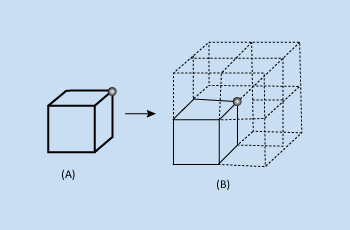
For enclosing the charge completely, seven more identical cubes are required. So total flux linked with the 8 cube system is ϕcube = (Q/ϵ0)
∴ Flux through the given cube ϕcube = (Q/8ϵ0)
Flux through one face opposite to the charge, of the given cube is ϕface = 
(Because only three faces are seen).
In a region, electric field depends on X – axis as E = E0x2. There is a cube of edge a as shown. Then find the charge enclosed in that cube.
1) 5ⅇ0 a4E0
2) 3ⅇ0 a4E0
3) 4ⅇ0 a4E0
4) Zero
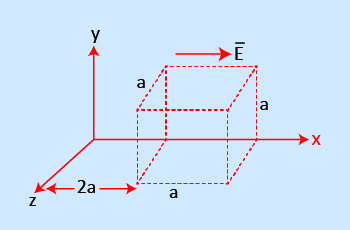
magnitude of electric field at left face EL = E0.(2a)2 = E0 4a2
at right face ER = E0.(3a)2 = E0 9a2
Π = (ER – EL)a2 = 5 E0 a4
∴ charge enclosed q = ⅇ0Π = 5 ⅇ0a4E0
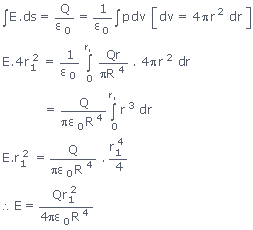
Let  be the charge density distribution for a solid sphere of radius R and total charge Q for a point 'p' inside the sphere at distance r1 from the centre of the sphere, the magnitude of electric field is


4) 0
According to Gauss law
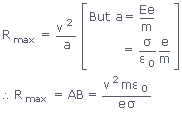
A large flat metal surface has uniform charge density +σ;. An electron of mass m and charge e leaves the surface at point A with speed v. and return to it at point B. The maximum value of AB is


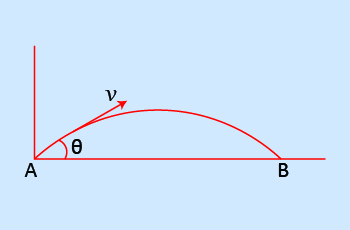
For maximum value of AB
θ = 45°