Examples
Differentiation of one function with respective to other function - Example
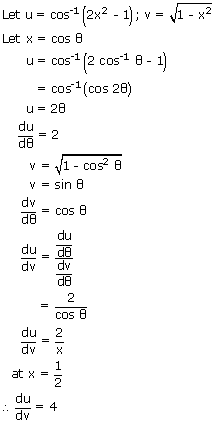
Ex:
Derivative of cos–1(2x2 – 1) with
respective to √(1 – x2) when x =  .
.
Sol:
Derivative of functions expressed in the determinant form - examples
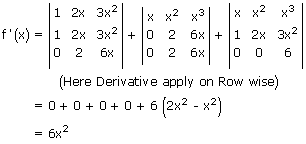
Ex1:
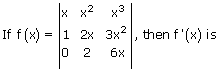
Sol:
Ex2:
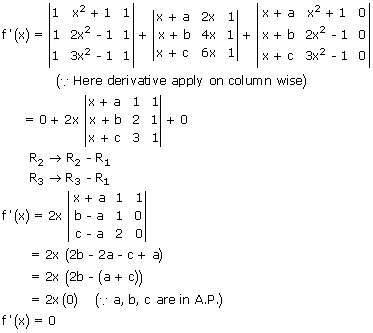
If a, b, c are in A.P. and f(x) = 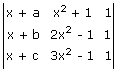 , then
find f
'(x).
, then
find f
'(x).
, then
find f
'(x).Sol:
Homogeneous functions - Examples
Ex1:
f(x, y) = 4x2y + 2xy2 is a homogeneous function of degree '3'.
Sol:
| Consider f(kx, ky) | = | 4(kx)2(ky) + 2(kx)(ky)2 |
| = | k3(4x2y + 2xy2) | |
| ⇒ f(kx, ky) | = | k3 f(x, y) |
| ∴ f(x, y) is a homogeneous function of degree '3'. | ||
Ex2:
f(x, y) = ax2 + 2hxy + by2 is a homogeneous function of degree '2'.
Ex3:
f(x, y) = 3x2 + 4xy2 +
7y3 is not a homogeneous function.
Here f(kx, ky) cannot be expressed in the
form of kn f(x, y).
⇒ Let f(x, y) = ax2 + 2hxy +
by2
⇒ If f(x, y) = 0
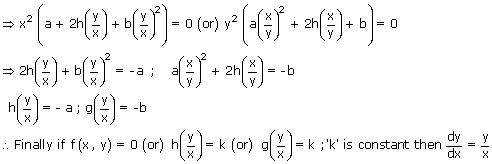
⇒ If f(x, y) = 0
⇒ ax2 + 2hxy + by2 = 0
Sol:
h = k
= k
= k
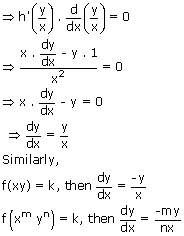
⇒ Differentiate with respect to 'x'
Ex4:
If xm yn = (x + y)m +
n, then  is
is
isSol:
Given that xm yn = (x + y)m + n
This is a homogeneous function with degree (m + n).
⇒ =
=
Ex5:
If xy = (x + y)n (n ϵ N) and =
, then
n
=
=
, then
n
=
Sol:
It must be homogeneous function.
⇒ n = 1 + 1
⇒ n = 2
Ex6:
If sin (xy) + tan (xy) = k, then =
=
Sol:
Given that sin (xy) + tan (xy) = k
Given condition is in the form f(xy) = k
⇒ =
–
=
–