Consider a thin spherical shell of radius R with a positive charge q distributed uniformly on the surface. As the charge is uniformly distributed, the electric field is symmetrical and directed radially outward (positive charge) in all directions. The magnitude of electric field is the same at all points that are equidistant from the shell. All such points lie on a sphere. So the symmetry here is spherical symmetry. Hence we shall use a spherical Gaussian surface to find the electric flux and hence the magnitude of electric field at a point inside and outside of the charged shell.
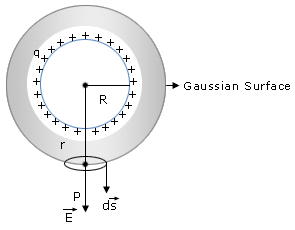
(a) Electric field outside the shell :
 is everywhere perpendicular to the Gaussian surface, the angle between and the elemental area
 is 0°. Moreover, E has the same value at all points on the surface, since they are equidistant from the charged shell. Being constant, E can be taken out from the integral,
and the total flux.
is 0°. Moreover, E has the same value at all points on the surface, since they are equidistant from the charged shell. Being constant, E can be taken out from the integral,
and the total flux.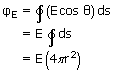

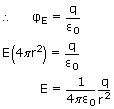
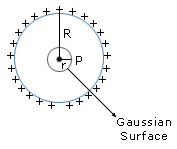
(b) Electric field inside the charged shell :


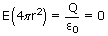
(c) Electric field on the surface of shell :
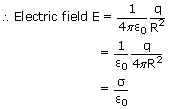
 is the surface charge density on the shell.
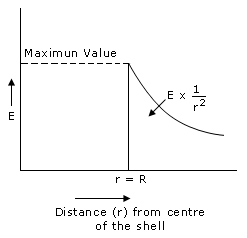
 The variation of electric field intensity with the distance from the center of a uniformly charged spherical shell is represented graphically below.
The electric field intensity varies inversely as the square of the distance from the centre, at a point outside the spherical shell.