Prove that the velocity at the end of flight of an oblique projectile is the same in magnitude as at the beginning but the angle that it makes the horizontal is negative of the angle of projection.
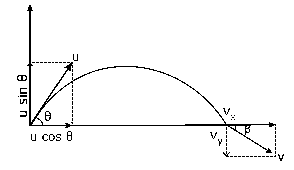
vy = u sin θ – gT


 is
is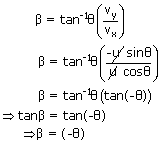
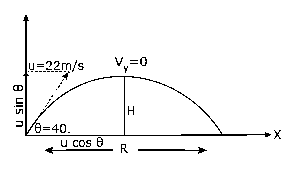
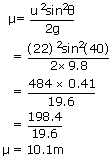
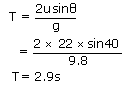
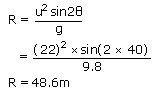
A football player kicks a foot ball at an angle θ = 40° above the horizontal axis with initial velocity 22m/s. Ignore the air resistance and find the maximum height that the ball attains, time of flight between kickoff and landing and the range of the ball ?
A football is kicked off with an initial speed of 19.6 m/s to have maximum range. Goal keeper standing on the goal line 67.4 m away in the direction of the kick starts running opposite to the direction of kick to meet the ball at that instant. What must his speed be if he is to catch the ball before it hits the ground?
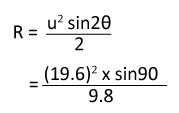
or R = 39.2 metre.
Man must run 67.4m – 39.2m = 28.2m in the time taken by the ball to come to ground time taken by the ball.
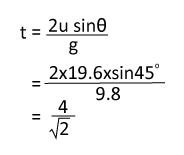
| t | = | 2&sqrt;2 |
| = | 2 × 1.41 | |
| = | 2.82 sec | |
| Velocity of man | = |  |
| = | 10 m/sec |
In the absence of wind the range and maximum height of a projectile were 'R' and 'H'. If wind imparts a horizontal acceleration a =(g/4) to the projectile then find the maximum range and maximum height.
| H1 | = | H (∴ u sinθ remains same) |
| T1 | = | T |
| R1 | = | ux + (1/2)aT2 |
| = | R + (1/2)(g/4)T2 | |
| = | R + (1/8)gT2 | |
| = | R + H | |
| R1 | = | R + H |
| H1 | = | H |
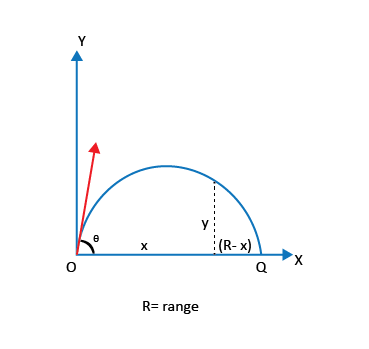
We know that the equation of the trajectory is
| y | = | x tanθ – 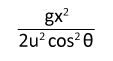 can be written as can be written as |
| y | = | x tanθ – 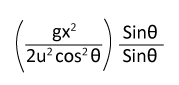 |
| &doublearrow; y | = | x tanθ – 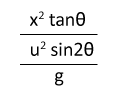 |
| y | = | x tanθ – 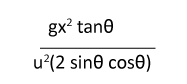 |
| y | = | x tanθ 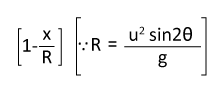 |